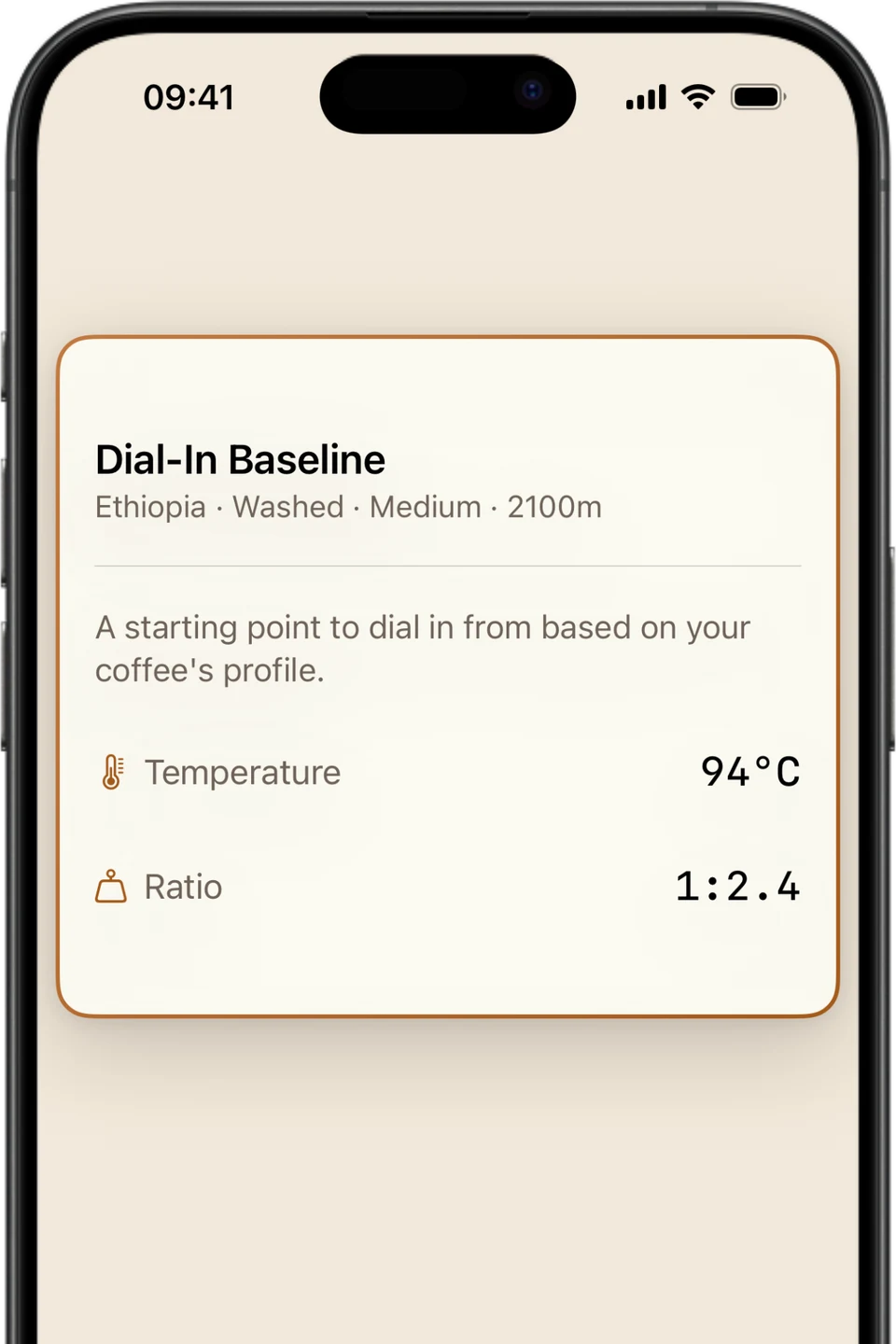
Dialing In New Coffee Beans: Read the Bag First
A new bag gives you useful clues before you grind a single dose. Roast, process, elevation and origin can move your starting temperature and ratio closer to the coffee's likely range, as long as you treat that baseline as a first attempt.
What a dial-in baseline can actually do
A baseline answers a narrow question: where should I begin with this coffee? Espresso Metrix uses four details from the bag and suggests a starting temperature and brew ratio. It does not claim to know the perfect recipe.
That distinction matters. The app cannot see your basket geometry, burrs, water or puck preparation. It also does not prescribe a grind setting, because grinder numbers do not translate between grinders. Shot time remains a diagnostic you record after brewing, not part of the baseline.
The four clues on the bag
These clues overlap, and they do not all carry equal weight. Roast is the most direct signal. Elevation can help describe density. Process often says more about the cup style you want to protect. Origin is a broad supporting clue, never a guarantee.
Roast
How far the bean has developed in the roaster strongly affects structure and solubility.
Process
Washed, natural and fermentation-led processes can point toward different starting styles.
Elevation
Higher-grown coffee is often denser, though variety and roast still matter.
Origin
A regional pattern can support the other clues, but it should never override specific bag details.
How roast level shifts the starting point
Roasting breaks down the bean's structure. As development increases, coffee generally becomes more porous and easier to extract. That makes roast the strongest input in the baseline.
| Roast | What it suggests | Starting direction |
|---|---|---|
| Light | Dense and slower to dissolve, with more brightness to balance | Hotter water and a longer ratio than medium |
| Light-medium | Still fairly dense, with acids beginning to sweeten | Slightly hotter and longer than medium |
| Medium | A balanced and forgiving reference point | Use the neutral baseline |
| Medium-dark | More soluble, with chocolate and caramel moving forward | Slightly cooler and shorter than medium |
| Dark | Porous and quick to give up solubles | Cooler water and a shorter, more concentrated ratio |
| Very dark | Fragile and highly reactive to extraction | Cooler still, with a conservative ratio |
These are starting directions, not quality judgments. A light roast does not have to become a long modern espresso, and a dark roast does not have to become a ristretto. Taste gets the final vote.
How process changes the cup you are protecting
Processing changes the bean's chemistry and sensory profile, but it does not produce one universal extraction rule. Espresso Metrix uses process as a smaller adjustment on top of roast and elevation.
| Process | Typical cup direction | How the baseline responds |
|---|---|---|
| Washed | Clear and origin-forward, often with prominent acidity | Leans toward a fuller extraction to build sweetness |
| Honey | More body and rounded sweetness than a typical washed coffee | Eases slightly cooler and shorter than washed |
| Natural | Ripe fruit, heavier body and high sweetness | Starts a little cooler and shorter, then moves carefully |
| Anaerobic | Intense fermentation-led flavor that can become harsh when pushed | Starts conservatively, then uses small adjustments |
| Monsooned | Low acidity, heavy body and earthy character | Leans cooler and shorter |
| Decaf | A more fragile bean structure after decaffeination | Leans cooler and shorter, with smaller moves |
| Blend or mixed process | A combination that may span several styles | Stays near the middle until taste supplies better evidence |
How Espresso Metrix groups elevation
For the Dial-In Baseline, Espresso Metrix groups the elevation entered from the bag into four bands, measured in meters above sea level (m a.s.l.). Elevation can offer a clue about density, but variety, climate and roast development can outweigh it.
| Elevation band | Range (m a.s.l.) | Likely signal | Starting direction |
|---|---|---|---|
| Very high | 2,000 and above | Often denser and slower to extract | Hotter and slightly longer than a low-grown coffee |
| Highland | 1,500–1,999 | Often dense, with brighter acidity | A little more heat and extraction than lowland |
| Midland | 1,000–1,499 | Near the middle of the app's elevation range | Little or no elevation adjustment |
| Lowland | Below 1,000 | Often softer and quicker to extract | Make smaller moves and avoid pushing too far |
How origin fits without stereotyping the coffee
Origin is the broadest input. It can help when a bag omits elevation or offers little processing detail, but a country contains many varieties, climates and roast styles. Espresso Metrix treats it as a supporting clue.
| Broad region | Common cup tendency | Baseline role |
|---|---|---|
| African | Often bright, floral or tea-like | Allows a little more heat or ratio to develop sweetness |
| Central American | Often balanced, with a wide sweet spot | Acts as the neutral reference |
| Brazil | Often lower in acidity and fuller in body | Leans a little cooler and shorter |
| Other South American | Often balanced in acidity and body | Stays close to neutral |
| Asia Pacific | Often earthy, full-bodied and lower in acidity | Leans cooler and shorter to protect clarity |
How Espresso Metrix combines the clues
The app does not apply four independent recipes. It starts from a medium, balanced reference and lets each known characteristic nudge the temperature and ratio. Some clues reinforce one another. Others pull in opposite directions. A light natural may ask for more extraction because of roast, then a slightly more conservative approach because of process.
From baseline to dialed-in recipe
- Add the bag details. Enter what the roaster provides. Missing information is fine. The baseline uses what it knows.
- Plan the first shot. Keep dose suitable for your basket, then use the suggested ratio to calculate target yield and set the starting temperature.
- Pull and record what happened. Log the actual dose, yield, time, grind and taste. The difference between plan and result matters.
- Adjust from taste. Use the Espresso Compass workflow to choose one next move. Do not keep changing the baseline itself.
- Save the winner. When the cup is balanced for you, mark that shot Dialed In. It is now your recipe for this coffee and setup.
The baseline saves you from beginning with no information. The shot log turns that informed first attempt into knowledge you can reuse.